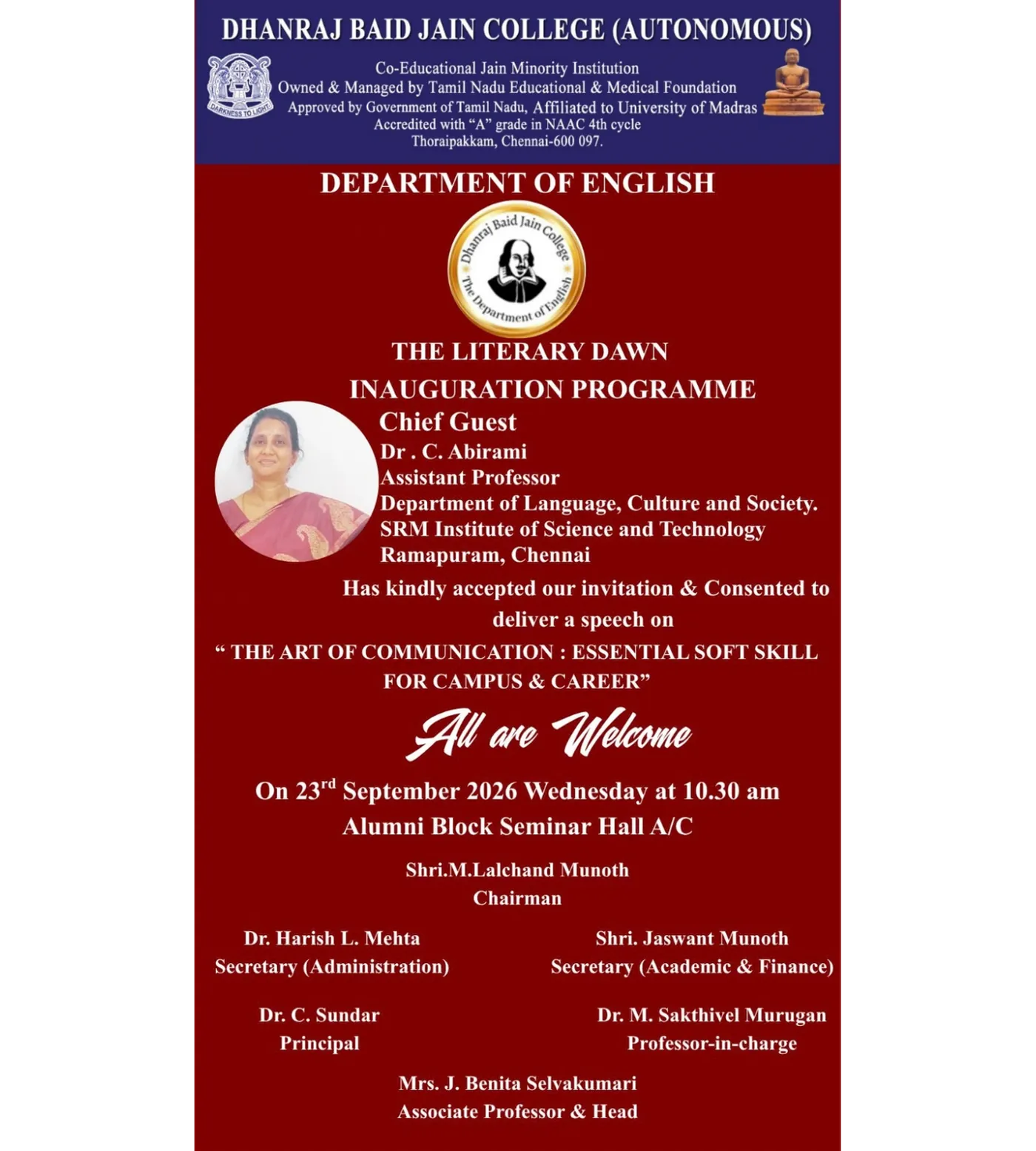





Department of English

ABOUT THE DEPARTMENT

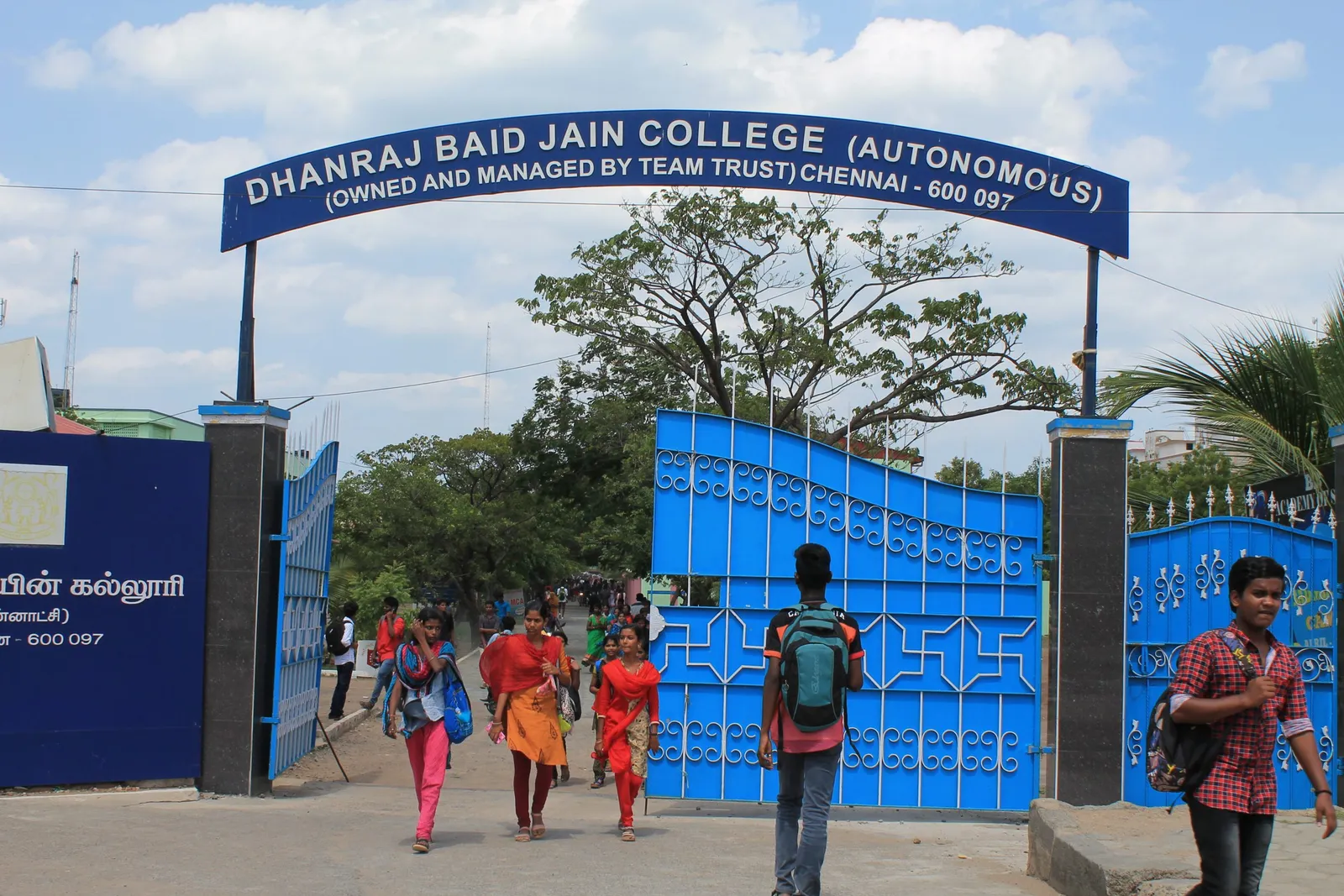
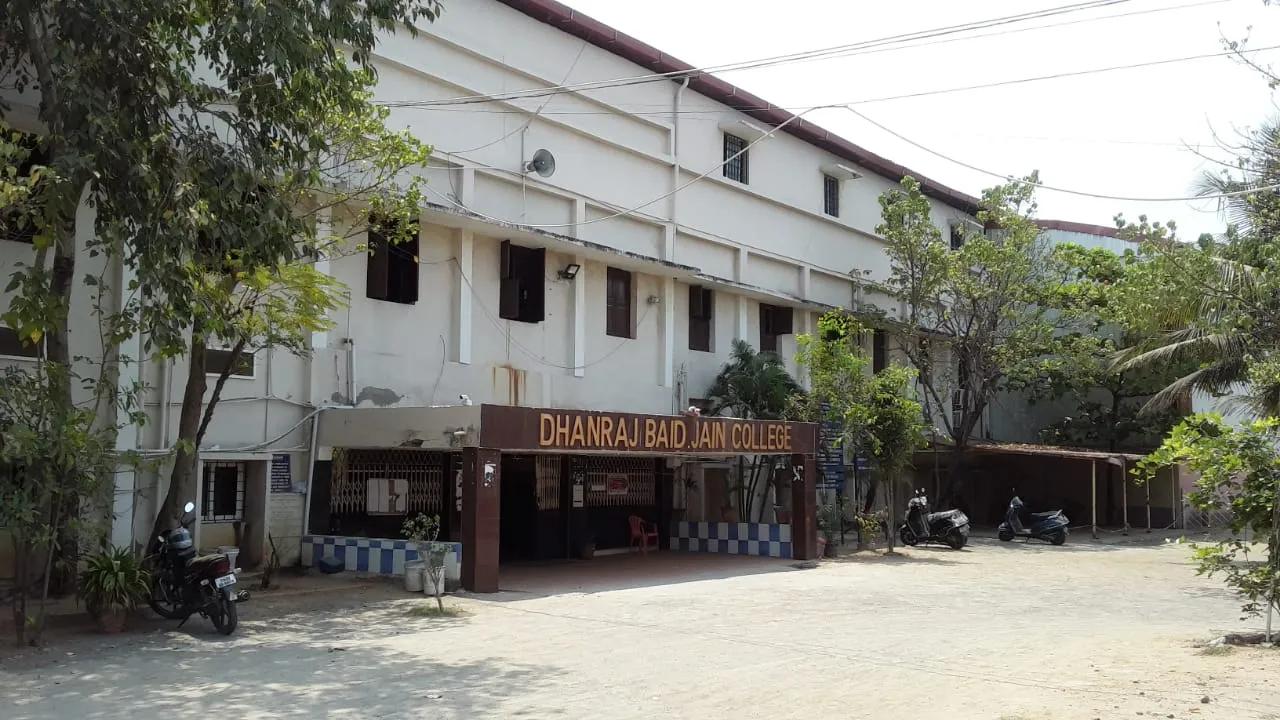
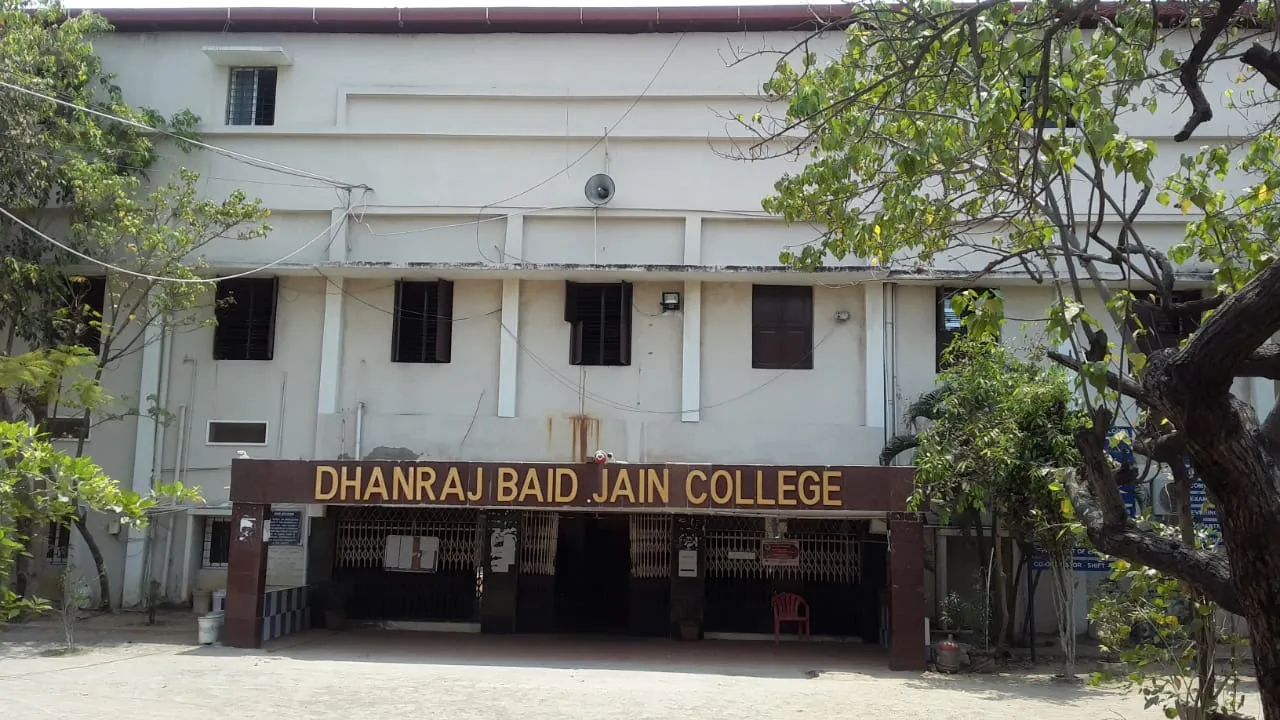
Dhanraj Baid Jain College was established in 1972 with a primary objective of providing higher education to deserving students. Students are admitted without any reference to religion, caste or creed. Right from the inception of the college, the department has been improving knowledge and communication skills of the students. The Department of English revamps English curriculum for every three or five years in order to enhance the learner’s requirement and empower them to meet the globalized job market.

CORE OBJECTIVES :

  • To develop the Students abilities in Grammar, Oral Skills, Reading, Writing & Study Skills.

  • To acquire Analytical & Logical thinking skills to pursue higher Education.
  • To cultivate an appreciation for diverse Literary tradition.
  • To encourage & Cultural, Social, Historical Contexts.

VISION MISSION

Vision

To become one of the leading departments in the institution by setting standards of excellence in innovative curriculum design, teaching, professional development and by using the resources of the language for creating a just, equitable and sustainable society.
Mission

Equip students with the skills required to master the English language and communicate effectively in English. Develop critical thinking and enable students to respond to the contemporary issues and problems in a mature, responsible and constructive manner. Use the English language as a tool to develop social responsibility, democratic temper and ecological consciousness. Assist students to gain empathy, sensitivity and tolerance through the study of language and the imaginative world of literature Nurture self- expression and the imaginative use of the language.
PROGRAMME OUTCOMES

  1. PO – 1 Disciplinary Knowledge: Capable of demonstrating comprehensive knowledge and
    understanding of one or more disciplines that form a part of an undergraduate programme of study.
  2. PO – 2 Problem Analysis: Identify and review literature, thereby analyzing problems to arrive at substantiated solutions using the basic principles of science.Critical Thinking: Capability to apply analytic thought to a body of knowledge; analyze and evaluate evidence, arguments, claims, beliefs on the basis of empirical evidence; identify relevant assumptions or implications; formulate coherent arguments; critically evaluate practices, policies and theories by following scientific approach to knowledge development.
  3. PO – 3 Problem Solving: Capacity to extrapolate from what one has learned and apply their competencies to solve different kinds of non-familiar problems, rather than replicate curriculum
    content knowledge; and apply one’s earning to real life situations.
  4. PO – 4 Analytical Reasoning: Ability to evaluate the reliability and relevance of evidence; identify logical flaws and holes in the arguments of others; analyze and synthesize data from a variety of sources; draw valid conclusions and support them with evidence and examples and addressing opposing viewpoints. 
  5. PO – 5 Scientific Reasoning: Ability to analyze, interpret and draw conclusions from quantitative/ qualitative data; and critically evaluate ideas, evidence, and experiences from an open minded and reasoned perspective. 
  6. PO – 6 Self-directed & Lifelong Learning: Ability to work independently, identify and manage a project. Ability to acquire knowledge and skills, including “learning how to learn”, through self- placed and self-directed learning aimed at personal development, meeting economic, social and cultural objectives.
  7. PO – 7 Reflective Thing: Critical sensibility to lived experiences, with self-awareness and reflexivity of both self and society
  8. PO – 8  Reading & Projects: Document their reading and interpretive practices in assignments, translation works, and independent projects.
  9. PO – 9 Confidence & Effectiveness: Confidently and effectively articulate their literary and textual experiences.
  10. PO – 10 Social Skills & Empathetic Approach: Reorganize a professional and reflective approach to leadership, responsibility, personal integrity, empathy, care and respect for others, accountability and self-regulation.

PROGRAM SPECIFIC OUTCOME

  1. PO – 1Acquire good knowledge and understanding, to solve specific theoretical & applied problems in different area of mathematics & statistics.
  2. PO – 2 Understand, formulate, develop mathematical arguments, logically and use quantitative models to address issues arising in social sciences, business and other context /fields.
  3. PO – 3 To prepare the students who will demonstrate respectful engagement with other’s ideas, behaviours, beliefs and apply diverse frames of references to decisions and actions. To create effective entrepreneurs by enhancing their critical thinking, problem solving, decision making and leadership skill that will facilitate start-ups and high potential organizations.
  4. PO – 4 Developing a research framework and presenting their independent ideas effectively.
  5. PO – 5 Equipping their employability skills to excel in professions like teaching and exposing them to various activities to empower them through communication skills.
  6. PO – 6 Enabling a holistic perspective towards the socio-political inequalities and environmental issues.

STAFF LIST

S.No
Employee ID
Name Qualification Designation
01 DBJCT0188 Mrs.J.Benita Selvakumari M.A., M.Phil., (Ph.D.,) Head & Associate Professor
02 DBJCT0197 Mrs.R.Smitha mary M.A., B.Ed., Assistant Professor
03 DBJCT0254 Mr.M.Ratheesh M.A., M.Ed., Assistant Professor
04 DBJCT0281 Mrs. M.Nandhini  M.A., M.Phil., Assistant Professor
05 DBJCT0282 Ms.RVM.Aarthi  M.A., (Ph.D.,) Assistant Professor
06  DBJCT0283 Ms.J.Esther Karolin Beulah M.A., M.Phil., (Ph.D.,) Assistant Professor
07  DBJCT0284 Mrs.V.MeenaKumari  M.A., M.Ed., M.Phil.,SET., Assistant Professor